| On This Page 1. What Is Smart Home Integration for Home Insurance? 2. The Devices: Leak Sensors, Shutoffs, and Thermostats 3. Does Hippo Give Smart Home Discounts? 4. How IoT Leak Detection Works 5. The Integration: Device APIs and Data Ingestion 6. The Smart Home Discount Engine 7. Privacy, Security, and Data Consent 8. Cost, Timeline, and Tech Stack 9. Real Case Study: A New Digital Product MVP 10. FAQs |
As a senior machine learning engineer at Acquaint Softtech, I work on systems that turn streams of device data into decisions, and smart home insurance is one of the clearest examples of why that matters. A water sensor that catches a leak at 2 a.m. can prevent a claim that would otherwise cost tens of thousands of dollars, and the insurer happily shares some of that saving as a discount.
We build these connected-insurance integrations through our software product development services, with the data ingestion and the risk logic designed together from the first sprint.
This is a fast-moving space, so it is worth naming the intent. Some readers want to understand how smart home insurance works and who offers discounts; some are comparing devices like Flo by Moen and Nest, and a smaller group is ready to build the integration and needs cost and stack. This article answers all three, and it treats security as a first-class concern, since home device data is sensitive and securing it follows guidance such as that from the US National Institute of Standards and Technology (NIST). For the broader engineering context, our master guide to InsurTech software development in 2026 maps where this fits.
What Is Smart Home Integration for Home Insurance?
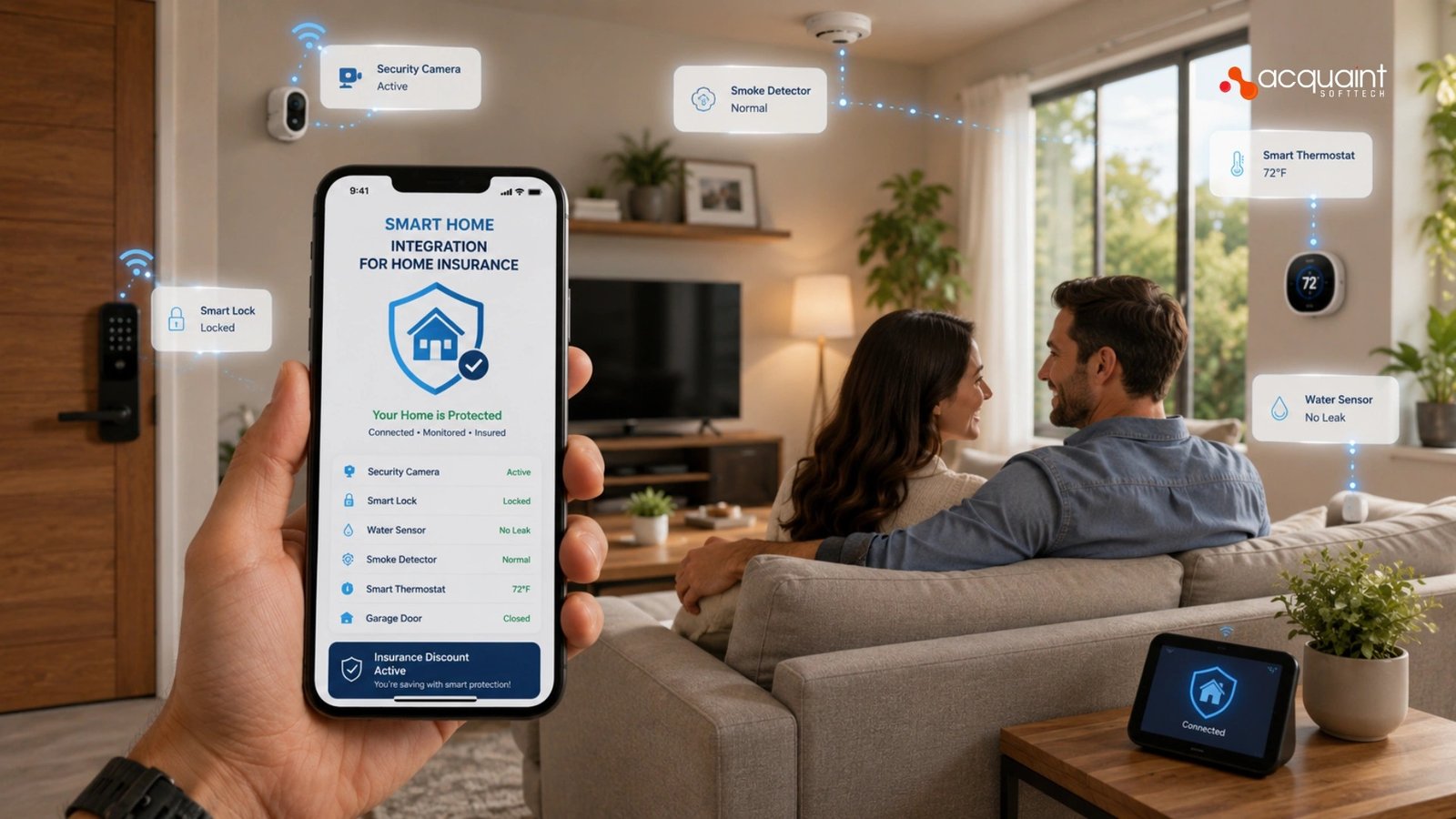
Smart home integration for home insurance is the connection between a homeowner’s IoT devices and their insurer, so that the devices reduce risk and the policy rewards it. The insurer ingests data and alerts from leak sensors, shutoff valves, thermostats, and security devices, uses them to prevent or reduce claims, and gives the policyholder a discount for installing and actively using them.
The logic is simple economics: a prevented claim is far cheaper than a paid one, so both sides win. Building this as a real data and integration platform is the work our dedicated software development teams scope from the start.
Why insurers care, and why now
Water damage is one of the most common and expensive home insurance claims, and freeze-related burst pipes can run from five to twenty-five thousand dollars each, so anything that catches these early pays for itself quickly. Devices have also become cheap, reliable, and connected enough that a mainstream program is finally practical, which is why carriers from large incumbents to InsurTech startups now run them.
The shift turns home insurance from purely reactive, paying after the damage, toward preventive, stopping the damage. That prevention-first model is the same direction the wider industry is moving, as covered in our guide to building an insurance underwriting platform.
The Devices: Leak Sensors, Shutoffs, and Thermostats
A smart home program revolves around a handful of device categories, and the platform has to support the ones the insurer chooses to reward. The big three are water leak sensors, automatic water shutoff valves, and smart thermostats, with security and smoke or electrical-fire monitors close behind. Each device type produces different data and prevents a different kind of loss. The mobile experience that helps homeowners pair and monitor these devices is built by our hired React Native developers.
Leak sensors and shutoff valves
Point leak sensors are small, inexpensive devices placed near water heaters, sinks, and washing machines that detect moisture and send an alert, cutting response time from days to minutes, though they do not stop the water themselves. Whole-home shutoff valves such as Flo by Moen are the higher-value option: installed in line, they monitor flow and pressure, learn the home’s normal usage patterns, and automatically shut off the water when they detect abnormal flow, even when nobody is home.
Carriers reward the shutoff valves most because the intervention is automatic rather than dependent on the homeowner being awake. This is the device category with the clearest return for an insurer.
Smart thermostats
Smart thermostats such as Nest and ecobee prevent a different loss: frozen pipes. They monitor the home’s temperature, offer freeze-protection modes, and can alert the homeowner or adjust the heat when temperatures approach dangerous thresholds, heading off a burst pipe before it happens.
Some carriers offer explicit thermostat discounts, especially in freeze-prone climates, and more broadly they fall into the protective-device category that carriers use to set premiums. The data they emit, temperature and occupancy patterns, is useful for risk but also sensitive, which is a theme we return to later.
Does Hippo Give Smart Home Discounts?
Yes. Hippo is the clearest example of the model: in eligible states it gives policyholders a complimentary smart home monitoring kit from partners and applies a discount of up to around 13% as long as the devices are installed and kept active.
By Hippo’s own figures, customers save on the order of sixty to ninety dollars a year depending on whether the kit is self-monitored or professionally monitored, and the kit is bundled into the policy rather than sold separately. The platform engineering that makes a program like this run is built by our hired Python developers, who own the device data pipeline behind it.
How the broader market structures discounts
Across the market, smart home discounts typically range from about five to twenty percent, with the larger savings reserved for professionally monitored devices, and many carriers also subsidize or discount the hardware itself. A recurring condition is data sharing: programs from carriers such as USAA and State Farm require the policyholder to connect at least one or two devices and share usage data to earn the discount.
The pattern to copy is that the discount rewards not just owning a device but keeping it active and sharing its signal, which is what actually reduces claims. Designing that incentive correctly is a product decision our virtual CTO services help carriers think through.
How IoT Leak Detection Works
IoT leak detection works by continuously watching for water where it should not be, then alerting or acting before the water becomes a claim. Point sensors detect moisture contact and push an alert; flow-based devices like Flo by Moen monitor the rate and pressure of water moving through the pipes, learn the home’s normal pattern, and flag or stop anything abnormal.
The smartest devices close the loop by shutting off the main valve automatically. The event-processing backbone that turns these signals into action is built by our hired DevOps engineers.
From alert to prevented claim
For the insurer, the value is in what happens after the alert. A leak signal can notify the homeowner, trigger an automatic shutoff, and, when damage does occur, open a faster and better-documented claim because the platform already knows when and where the water started. The flow data also distinguishes a catastrophic burst from a dripping tap, so the response matches the severity.
Wiring this alert-to-action-to-claim path is the same intake-and-automation discipline described in our guide to insurance claims automation, and the device makers reinforce it with guarantees, with some covering a portion of the deductible if their shutoff fails to work as designed.
The Integration: Device APIs and Data Ingestion
The core of the build is integration: connecting to each device maker’s cloud, ingesting the data and alerts, and normalizing them into one consistent view the insurer can act on. Device makers expose APIs and webhooks, and each has its own data shape, authentication, and rate limits, so the platform’s job is to translate them all into a common model of homes, devices, and events.
Getting this layer clean and reliable is what makes everything downstream possible. The ingestion pipeline and the connectors behind it are built by our data engineering and AI development services.
Ingesting Nest, Flo, and sensor data
Thermostat data from a platform like Nest, flow data from a device like Flo by Moen, and moisture alerts from point sensors all arrive differently: some as periodic telemetry, some as real-time event webhooks, and some only on demand. The platform should accept a leak or freeze alert instantly through a webhook, store time-series telemetry efficiently, and reconcile device status so it always knows which homes have active, healthy devices.
Storing this high-volume, time-stamped data correctly is where our database optimization services focus, with the streaming ingestion patterns drawn from our guide to integrating AI and machine learning.
Detecting the events that matter
Raw telemetry is not useful until it becomes events: a leak, a freeze risk, a device that has gone offline, or a home that has stopped engaging with its kit. Lightweight anomaly detection turns continuous flow and temperature readings into these meaningful signals, and the same models can score each home’s risk over time. Keeping that detection accurate, so a long shower is not flagged as a burst pipe, is the modelling work our hired AI and ML engineers own.
The Smart Home Discount Engine
The discount engine is where device data becomes money: it decides which policyholders qualify for a discount, how large it is, and whether it continues. The cleanest design rewards three things in order: installing the device, keeping it active and connected, and sharing its data, because only an active, monitored device actually reduces claims.
The engine applies the resulting credit to the premium and re-checks eligibility over time. The rating and policy systems this connects to are described in our modern core insurance platform guide.
Can Nest data reduce premiums?
Yes, with some carriers and in the right conditions. A smart thermostat’s data signals lower freeze risk, and a handful of carriers offer explicit thermostat discounts, particularly where frozen pipes are a real threat, while many more count it within the protective-device category that shapes the premium.
The key engineering point is that the discount should track continued, active use rather than a one-time install, so the engine needs the live device signal, not just a checkbox at onboarding. Building that ongoing eligibility logic, and keeping it compliant as rate rules change, is the kind of work our software development outsourcing teams handle, with the rating rules kept current by our version upgrade services.
Privacy, Security, and Data Consent
Because a smart home program ingests data about when people are home, how they use water, and how warm they keep the house, privacy and security are part of the architecture, not a policy footnote. Insurer databases holding this data are attractive targets, so the platform needs encryption, strict access control, and a clear, revocable consent model that tells homeowners exactly what is collected and why.
Designing this from the start, following recognized IoT security guidance, is the kind of judgment our discovery workshop establishes before any device is connected.
Consent and data minimization as architecture
Practically, the platform should collect only the data the program needs, make consent explicit and easy to withdraw, and keep a clear record of what each home shared in exchange for its discount. It should also secure every integration, since each connected device cloud is another door into the system, and treat device data with the same care as any other sensitive personal information.
Keeping this secure and compliant over time, across device firmware and partner API changes, is the ongoing work our support and maintenance services are built to handle, often for carriers running the program under their own brand through our white label development services.
Cost, Timeline, and Tech Stack
A focused smart home integration MVP, connecting one or two device clouds such as a leak device and a thermostat, ingesting telemetry and alerts, and running a basic discount engine with a homeowner app, typically starts around $70,000 to $120,000 and takes a few months, while a full platform with many device partners, real-time event processing, anomaly and risk models, and a discount engine tied into rating runs well beyond that.
Cost scales with the number of device integrations and the depth of the models, not with the screens. Teams that need to add this capacity quickly do so through our IT staff augmentation services, or by engaging a full team of dedicated developers.
The smart home integration tech stack
The stack pairs a real-time ingestion layer with a time-series store and a clean integration backend. Python handles the device connectors, ingestion, and anomaly models; a backend in Node.js or Laravel exposes the home, device, and discount APIs; a time-series database stores telemetry while a message queue carries real-time alerts; and a web dashboard gives the insurer operational visibility. The choice is about reliability and security, not benchmarks. The admin and homeowner dashboards on top of this are built by our hired MERN stack developers.
| Layer | Recommended tech | Role in the platform |
| Ingestion | Python connectors | Device APIs, webhooks, telemetry |
| APIs | Node.js or Laravel | Home, device, and discount services |
| Storage | Time-series DB + queue | Telemetry and real-time alerts |
| Intelligence | Python models | Anomaly detection and risk scoring |
India-based teams deliver the same engineering quality at up to 40% lower cost, and the smart path is to integrate one device partner end to end, prove the ingestion, alerting, and discount loop, then add partners and models. Because device APIs and rate rules change, ongoing maintenance is part of the budget rather than an afterthought.
Read Also: The MK-677 “Best Vendor” List Is Solving the Wrong Problem
Real Case Study: A New Digital Product MVP
Acquaint Softtech built a new digital product MVP for a client launching into an unfamiliar market, where the whole point was to win adoption quickly and prove the model before scaling.
This is a real, Clutch-verified engagement, and although it is not a smart home program, it is a strong proxy because a connected-insurance program lives or dies on the same things: getting users to adopt and stay engaged, and turning that engagement into measurable savings. It is documented among Acquaint Softtech’s case studies.
The challenge and what Acquaint Softtech delivered
The client needed to launch a new product fast, drive real usage, and show a return rather than just shipping features. By leveraging expert resources, including the option to hire Laravel developers, the team delivered a successful MVP that achieved strong user adoption and engagement, reduced anomalies, produced cost savings, and earned high customer satisfaction.
Those outcomes map directly onto a smart home program, where success means homeowners actually install and keep using their devices, and the insurer sees fewer and smaller claims as a result. It is the same adoption-and-savings discipline we apply when an insurer asks us to turn a device integration into a program people use and a loss ratio that improves.
| Outcome | Before | After | |
| Adoption | Unproven concept | Strong user adoption and engagement | |
| Cost | Higher operating cost | Measurable cost savings | |
| Satisfaction | Untested | High customer satisfaction | |
FAQs
Does Hippo Give Smart Home Discounts?
Yes, Hippo offers smart home discounts in eligible states when approved smart devices are installed and actively monitored. Discounts can reach up to 13%, helping homeowners lower annual insurance costs. Savings vary based on device type and monitoring level.
How Does IoT Leak Detection Work?
IoT leak detection uses sensors to identify moisture, abnormal water flow, or pressure changes in real time. Advanced systems can automatically shut off water to prevent major damage. Faster alerts help reduce losses and support quicker insurance claims.
Can Nest Data Reduce Insurance Premiums?
Yes, smart thermostats like Nest can help lower premiums with some insurers. They reduce freeze-related risks and improve home protection monitoring. Discounts usually depend on active and ongoing device usage.
How Much Does Smart Home IoT Integration Cost?
More advanced platforms with multiple device partners, AI models, and rating integrations require a larger budget. Development costs can be reduced by up to 40% with India-based teams.
| US Cost | UK Cost | Europe Cost |
| $70,000–$120,000 | £56,000–£96,000 | €65,000–€112,000 |
What Devices Qualify for Smart Home Insurance Discounts?
Water leak sensors, smart thermostats, smoke detectors, security systems, and automatic shutoff valves commonly qualify. Professionally monitored devices often receive higher discounts. Most insurers require the devices to remain active.
How Long Does It Take to Build a Smart Home Insurance Integration?
A basic smart home insurance integration usually takes 3–5 months to develop. Multi-device platforms with real-time analytics and insurer integrations require more time. Device connectivity and discount engine development drive most timelines.
What Tech Stack Is Best for Smart Home Insurance Integration?
Python is commonly used for device integrations, data processing, and anomaly detection. Node.js or Laravel works well for APIs and business logic. Time-series databases, message queues, and web dashboards support real-time monitoring and insurer operations.